

For concerns about colic or potential laminitis in your horse or pony, the safest policy is to:
Forage should be number 1
before any hard feed rations.
Weight is hard to shift.
Get in early before weight goes on.
Check crest for firmness.
A hard crest is a precursor to laminitis.
“Both horses and ponies are prone to rapid weight gain in spring or autumn. This can be an unsafe time and steps are necessary to manage”
TIP: Wander around your horses’ paddocks and identify the paddocks with low sugar varieties as this can vary greatly paddock to paddock. If possible, select the paddocks with the most suitable more high fibre grasses.
TIP: The best grasses for horses are those high in fibre and low in sugar, such as Timothy, Brown Top and Cocks foot.
Kikuyu and Yorkshire fog are low sugar types and ok in some moderation too.
With Kikuyu -ensure additional calcium is added to make up for the reducing effect on calcium this grass has.
Grasses that worst for horses, particularly when fast growing are Rye and Clover. These are not safe for susceptible horses and ponies most of the year and require strict pasture management to avoid problems such as obesity, fizzy behaviour, colic or laminitis in your horse or pony.
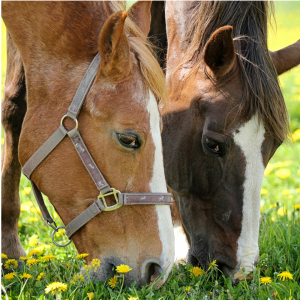
TIP: During warm weather early mornings have the lowest grass sugar. If your horse or pony is a good doer – use this early morning window to graze.
During cold or changeable weather (and where it is very cold overnight) early mornings may be higher in sugar. In these cases, turn out later in the morning as your grazing window once things have warmed up.
TIP: To save your paddocks it is usually best to graze by taping an area and moving out as the horse eats. Or for susceptible ponies they may need a track option or even a dry lot track (without grass) for their management.
Some metabolic ponies or older horses may also have Cushing’s disease or insulin resistance needing special care to avoid repeat bouts of laminitis or founder. They need to live on low sugar/starch diets with less to no grass and a strict high fibre hay and specialized diet to meet their needs.
TIP: ensure the grazing horse has access to some hay or straw whilst grazing.
Regular balanced hoof trims are imperative to maintain the balance of the correct heel to toe alignment.
It is common place to see miserable ponies locked up with very little to eat. This is unfair and not a great life.
These tips will have your horse happy and healthy and not standing idle and miserable!
TIP: If possible select the paddock with the lower grasses to set up your grazing regime.
TIP: Strip graze and hang a couple of hay nets around the paddock or consider supplying barley straw in place of hay if the horse or pony is likely to gain weight.
Barley straw has the benefit of being low starch and sugar with a low-calorie content, whilst being highly palatable!
In New Zealand we recommend the straw warehouse who deliver nationwide,
TIP: Soak hay for 1 hour to reduce sugars (if need be and sometimes longer).
We recommend soaking only in cool weather or if the horse is going to immediately consume. If warmer weather always be sure to hang in a cool area to help prevent any fermentation (or consider barley straw in place of).
TIP: Make your grazing an oblong shape instead of square – this encourages movement and adds interest.
Usually, a track system is the best which creates movement. But do watch the amount of grass growing on your track, particularly if the grass is actively growing.
TIP: Make use of hills! Set up your oblong pattern on a hill side to promote exercise.
TIP: Aim to make your Oblong longer each day to form a small track!
Mag-Eze is recommended for healthy metabolic function.
Mag-Eze chelated magnesium has a role in healthy function of metabolic horses and ponies and assimilation of fat.
Chromium (organic) is also a proven element to enhance metabolism.
Sudden increase in weight.
Fatty deposits over body such as crests, buttocks, tail head.
Hard crest fat and bounding digital pulse (these are a warning that laminitis is imminent).
Horse not eating, off feed or over- eating (may result in a digestive upset or colic).
Watch how your horse is walking. Sudden stiffness, walking short or appearing to walk on egg shells may be early signs of laminitis.
Enjoy hassle-free shopping with free delivery on orders above $250. We ensure your equine health essentials reach you conveniently and affordably.
Count on us for reliable and predictable delivery times. We understand the importance of timely supply for your horse's well-being.
Discover a comprehensive selection of products designed to enhance your horse's health and performance. From essential supplements to specialized health supplies, find everything you need at NPC Health.
At NPC Health, we uphold the highest standards of quality assurance. From formulation to delivery, we ensure that each product meets rigorous quality benchmarks, providing you with peace of mind and your horse with optimal health benefits.